



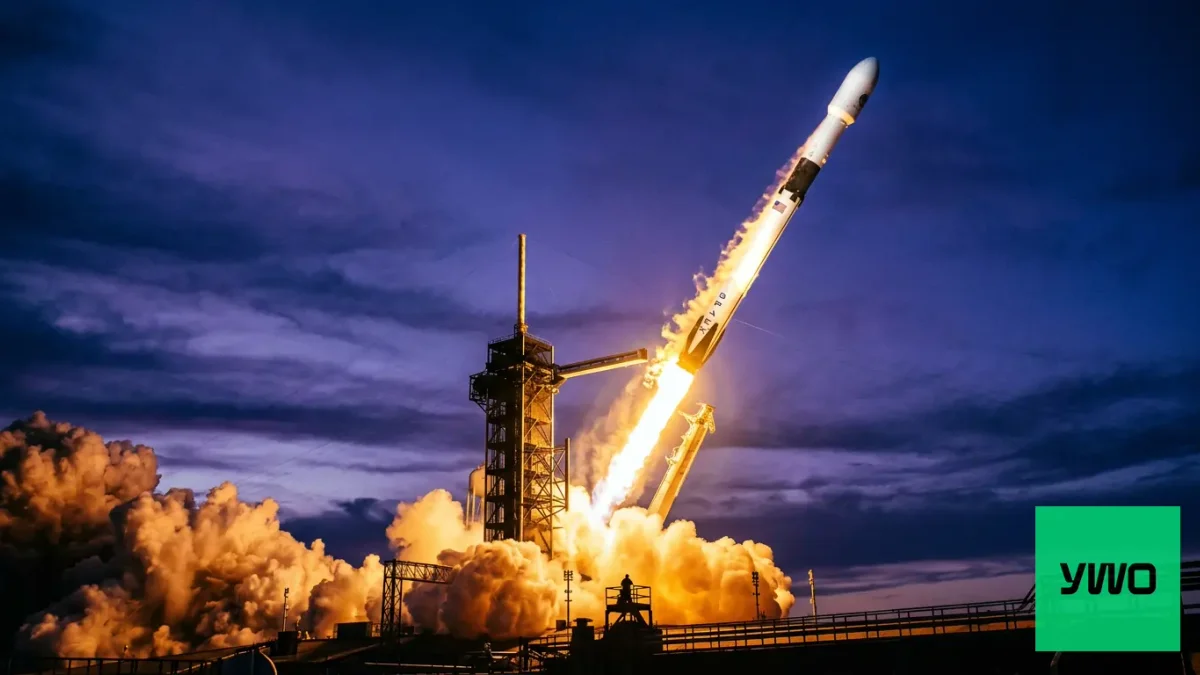
The crypto crowd is pricing in a 20% first-day pop for SpaceX. The fact that they peaked above $220 and have since retreated to $162 may indicate that initial enthusiasm has moderated compared with earlier trading activity.
:
Crypto traders on Hyperliquid are pricing SpaceX pre-IPO perpetual futures at around $162, roughly 20% above the company’s fixed IPO price of $135 per share, according to CNBC’s Tanaya Macheel. The same contract launched in May and briefly exceeded $220 before pulling back sharply — a move that coincided with Bitcoin and Ether each declining 20% and 23%, respectively, in the same period. SpaceX perpetual futures on Binance were trading at a similar level to Hyperliquid. While perpetual futures may provide insight into market sentiment, they should not be viewed as indicators of future market performance.
Crypto Perps as a Sentiment Gauge, Not a Price Target
The mechanics here are worth holding in mind. Perpetual futures let traders speculate on price with leverage and no expiry date, without owning the underlying asset. They account for more than 70% of all volume on centralised global crypto exchanges, according to CoinGecko. The participants are, by construction, high-velocity and risk-tolerant — not the passive-fund managers who will ultimately determine where SpaceX settles after index inclusion.
Eric Chen, co-founder and CEO of Injective Labs, put it plainly in a note cited by Macheel: “These markets are dominated by very active, risk‑tolerant traders, and they aren’t pricing in a massive premium versus other pre‑IPO names. It’s a useful signal, but not a guarantee of how the broader market will react once SpaceX actually lists.” His follow-on observation carries more weight: the most optimistic participants still aren’t extremely bullish, which raises questions about how durable that demand is once real liquidity and price discovery arrive.
SpaceX is reportedly running four times oversubscribed going into Friday’s Nasdaq debut. At the $1.77 trillion target valuation, the company would instantly rank as the seventh-largest public company in the United States, surpassing Tesla based on its current market capitalisation.
The $135 Take-It-Or-Leave-It Price and What It Signals
SpaceX took the unusual step of setting a fixed price of $135 per share rather than offering a price range that adjusts with demand — the customary IPO mechanism. The company is also targeting a 30% retail allocation, amounting to approximately $22.5 billion directed toward individual investors, per CJ Haddad’s reporting for CNBC. Fidelity has already reduced its IPO eligibility threshold — normally set at $100,000 or $500,000 in household assets depending on the deal — to as low as $2,000 specifically for this offering.
The fixed-price structure removes one of the market’s usual pressure valves. In a conventional book-build, weak demand shows up in a cut to the range; here, the price is the price. The fixed-price structure differs from traditional IPO book-building processes and may influence how market participants interpret initial trading activity.
Where the Money Comes From — and Who Feels the Drain
Market participants have been discussing whether the IPO could influence capital allocation across certain sectors.. Tobias Burns at CNBC reports that analysts aren’t unanimous, but the Magnificent Seven has become the focal point of reallocation speculation.
Jane Gibbons at Jefferies wrote in a June 5 note to clients: “Increasingly, attention has centered on the Mag 7 and [technology, media and telecom stocks] more broadly as the most likely pocket of the market to absorb selling pressure.” Viraj Patel, global macro strategist at analytics firm Vanda Research, flagged in the same piece that retail activity has recently been “a bit flat,” with his hypothesis being that some of that represents dry powder being held back for the SpaceX listing. “People [could be] holding back from buying things like Nvidia and Tesla,” Patel told CNBC (Source: CNBC).
Some analysts have highlighted potential effects arising from index inclusion and associated portfolio rebalancing activity. . SpaceX is being fast-tracked into major benchmarks, including the Nasdaq 100 and FTSE Russell indices. Index-tracking funds may adjust portfolio holdings in accordance with their benchmark methodologies following inclusion decisions. . That’s a structural flow, not a discretionary one.
VanEck product manager Nicholas Frasse was direct on the sector-level implications: “We could see interest shift to individual names such as SpaceX,” he told CNBC via email. Given VanEck’s exposure to both space-themed and semiconductor ETFs, that’s a relevant observation rather than a detached one (Surce: VanECK).
Some market commentators have suggested that sectors which have experienced strong recent performance could be closely monitored for signs of portfolio reallocation. . Some names in the space ran hard through April and May. Any changes in investor positioning could affect market activity across a range of sectors, although outcomes remain uncertain.
Recent market commentary has highlighted changes in trading activity among large-cap technology stocks ahead of the IPO.
The Warren Letter and the SEC Window
Senator Elizabeth Warren sent a 12-page letter to the SEC on Tuesday calling for a delay to the IPO, shared with CNBC’s CJ Haddad. Warren cited three concerns: potential “inaccurate or misleading accounting or valuation” around SpaceX’s acquisition of Elon Musk-owned xAI; conflicts of interest stemming from Musk’s “uniquely unchecked” power as majority shareholder; and the risk that fast-tracking the company into major indices would effectively force passive investors into SpaceX exposure without meaningful opt-out.
“For investors who pick and choose their specific investments, they at least are able to avoid investing in companies that engage in risky or unfair practices,” Warren wrote. “But the SpaceX IPO creates a new concern: that major stock market indexes are being rigged in a way that would force millions of investors in passive index funds … to invest in SpaceX and face exposure to SpaceX’s significant risks with no choice in the matter. Source: Yahoo FInance“
CNBC reports it has reached out to SpaceX and SEC Chairman Paul Atkins for comment. As of this article’s publication, no public response has been issued. The SEC could theoretically delay the registration statement’s acceleration — but with the IPO scheduled for Friday and the book reportedly four times oversubscribed, the political and commercial momentum is heavily against any last-minute intervention. The potential regulatory implications of the letter remain uncertain.
The xAI acquisition concern is distinct from typical governance risk. It goes to whether SpaceX’s disclosed financials accurately represent the terms of a related-party transaction with another Musk entity — a question auditors and the SEC’s review process are supposed to address, but which isn’t publicly resolved as of today. That’s the specific red flag MarketWatch has also flagged in its analysis of risks embedded in the offering.
The Counterargument: Additive, Not Redistributive
Not everyone expects a meaningful reallocation. Paul Meeks, sell-side head of tech research at Freedom Capital Markets, told CNBC he doesn’t see a transfer out of the Mag Seven. His reasoning: AI infrastructure investment continues to be an important area of focus for many market participants.
.he hyperscalers executing that spend are almost entirely the same Mag Seven names, and SpaceX is more likely to attract incremental capital than to cannibalise existing tech positions. “I think money might come out of other investments to invest in those IPOs,” he said.
Patel at Vanda also raised the possibility that SpaceX becomes part of a Mag 10 — additive to overall tech volumes rather than a zero-sum rebalancing. With Anthropic and OpenAI reportedly expected to list later this year at valuations approaching $1 trillion each, that framing could shift quickly. Three multitrillion-dollar listings in a calendar year is a different market-structure problem than one.
The honest answer is that the distribution of retail-fund flows into an offering this size is genuinely uncertain. The perps are one signal. The four-times oversubscription is another. Neither provides certainty regarding future market performance following the IPO.
What’s Next
- Friday, 13 June 2026 — SpaceX Nasdaq debut. The company is set to begin trading. The opening print, relative to the $135 fixed IPO price, will be the first hard data point on whether the perp market’s 20% premium call was directionally correct.
- Ongoing — SEC response to Warren letter. SEC Chairman Paul Atkins has been contacted for comment. Market participants may continue to monitor any regulatory developments relating to the IPO.
- Market participants may continue to monitor developments related to index inclusion and portfolio rebalancing following the listing. .
Risk Disclaimer: Trading CFDs involves substantial risk and may not be suitable for all investors. CFDs are complex instruments and come with a high risk of losing money rapidly due to leverage. You may lose some or all of your invested capital. You should consider whether you understand how CFDs work and whether you can afford to take the high risk of losing your money. Past performance is not a reliable indicator of future results. This article is provided for general informational and educational purposes only and does not constitute financial, investment, legal, tax, or trading advice, nor a recommendation, solicitation, or offer to buy or sell any financial instrument.