



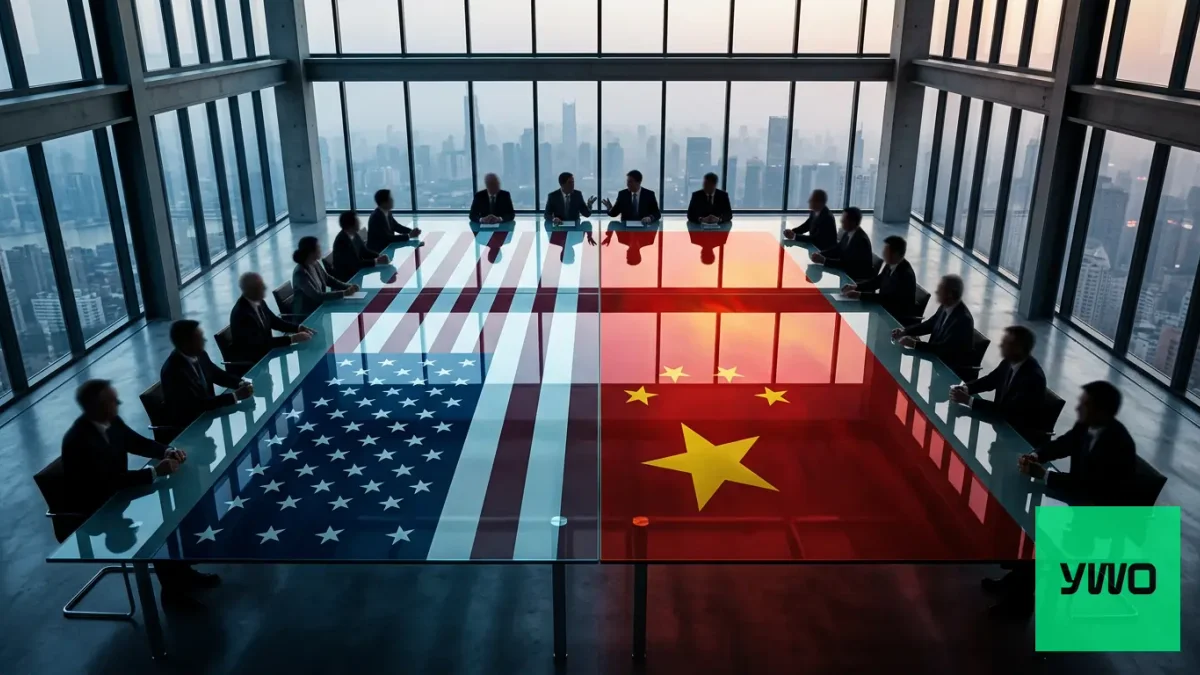
The Beijing summit on Thursday and Friday is less a diplomatic courtesy call than a stress test for every assumption the market has been making about the US-China trade truce — and with Boeing and Citigroup CEOs boarding the plane alongside Trump, the White House is making clear this is about deal flow, not just atmospherics.
Kevin Breuninger at CNBC reports that potential deliverables include Chinese purchases of US agricultural products and Boeing aircraft, with the White House framing the trip around “rebalancing the relationship with China and prioritizing reciprocity and fairness to restore American economic independence,” per spokeswoman Anna Kelly. For BA, the optics alone matter: a headline Chinese aircraft order has historically influenced Boeing share price sentiment, even when details remained limited . For CNY and SPY, the read-through is about whether the summit produces enough substance to sustain whatever trade-optimism premium is already sitting in the tape.
Analysts Highlight China’s Role in Regional Diplomacy
The complication that the White House framing doesn’t address is Iran — and it may be the summit’s most consequential thread.
The US and Israel launched attacks on Iran on 28 February. The Trump administration had publicly framed this as a four-to-six-week endeavour. It is now May. That timeline miss has reshuffled the geopolitical board heading into Beijing.
“It provides China a degree of leverage,” Arthur Dong, professor of strategy and economics at Georgetown University’s McDonough School of Business, told CNBC. “China has a significant amount of influence over Iran.”
Beijing is Iran’s largest trade partner and top buyer of its oil. Iran’s foreign minister visited Beijing last week — the first such meeting since hostilities began. Putin is expected in Beijing days after Trump departs. The sequencing is deliberate: Xi has constructed a diplomatic calendar that puts him at the centre of every live conflict simultaneously, and Trump is flying into that arrangement.
For energy markets, the Iran war has already produced what Breuninger describes as “a historic global energy supply shock,” spiking oil, gas, and fertiliser prices. Trump arrives in Beijing with record-low voter popularity and rising domestic fuel costs — which may increase the importance of energy and geopolitical discussions during the summit.
Low Expectations Are the Consensus — Which Is Its Own Risk
Kyle Chan, an expert on US-China relations at the Brookings Institution, framed the baseline bluntly: the two leaders want to “reconfirm their relationship and have that kind of stability. All the other stuff is gravy.”
That is the analyst consensus — keep expectations low, treat anything concrete as upside. The risk to that framing runs in both directions.
If the summit produces more than a photo opportunity — a credible Boeing order, a Chinese agricultural-purchase commitment with numbers attached, any diplomatic signal on Iran — SPY and BA could see increased upside pressure, with names carrying significant China revenue exposure likely reacting first. In FX markets, traders may closely monitor the yuan’s performance against the dollar; a softer USD/CNY move following the summit could suggest markets are interpreting the outcome as a more meaningful improvement in relations rather than purely symbolic diplomacy.
The downside scenario is Taiwan. The article notes that Taiwan’s long-standing status dispute is “expected to loom large” over discussions. Any deterioration in tone there — any language that markets read as US concessions on Taiwan in exchange for trade relief — could reprice risk across the region. That is a different kind of negative than a summit that simply produces nothing.
Trump’s own Truth Social post on Monday — “Great things will happen for both Countries!” — is the kind of pre-positioning that raises the bar for the outcome without specifying what clears it. If Thursday’s meetings deliver less than the hype implies, market volatility may increase if outcomes fall materially short of expectations.
What’s Next
- Thursday–Friday, 14–15 May 2026: Trump-Xi summit, Beijing. Watch for joint communiqué language on trade, and any statement — or deliberate silence — on Taiwan and Iran. No primary calendar source; event confirmed via CNBC.
- Ongoing: Weekly EIA crude inventory data, relevant given the Iran-driven energy supply shock — EIA.
- Ongoing: Fed communications calendar for any rate-path commentary that could interact with a trade-deal outcome — Federal Reserve.
Risk Disclaimer: Trading CFDs involves substantial risk and may result in the loss of your invested capital. CFDs are complex instruments and come with a high risk of losing money rapidly due to leverage. You should consider whether you understand how CFDs work and whether you can afford to take the high risk of losing your money. Past performance is not indicative of future results. This content is for informational and educational purposes only and does not constitute investment advice.