

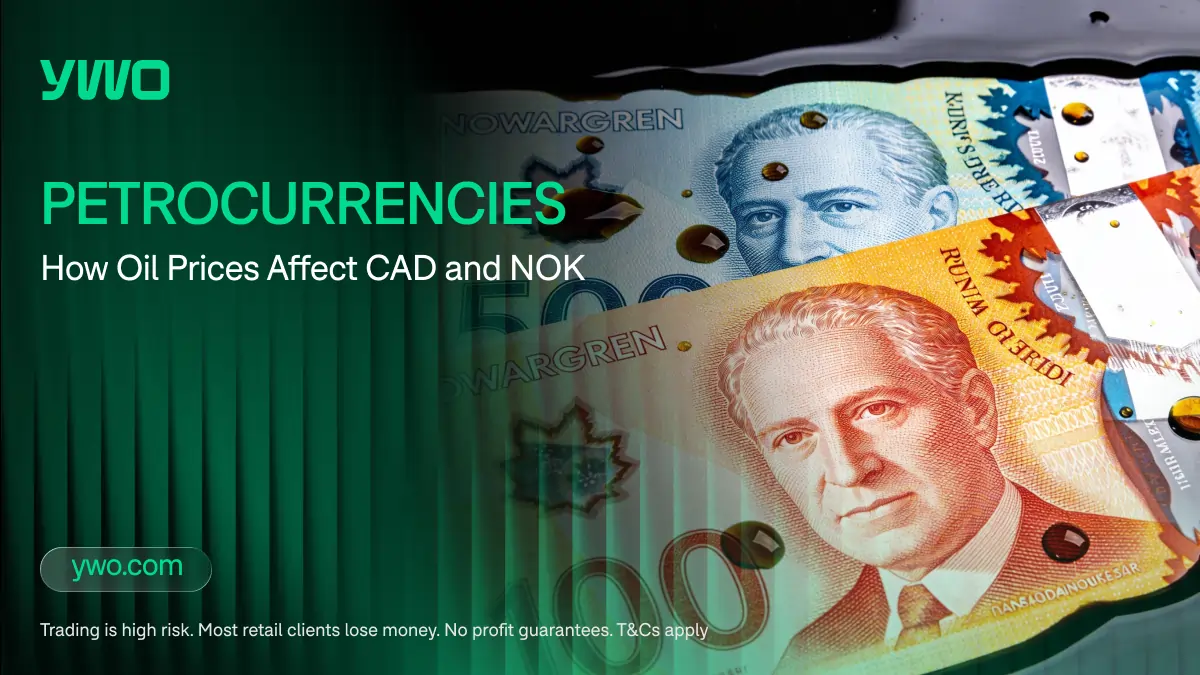
If you think the forex market is just about interest rates and central bank speeches, you are missing half the picture. Some currencies are closely linked to commodity exports — especially oil. s.
Welcome to the world of Petrocurrencies.
These are currencies belonging to nations whose economies are significantly influenced by oil exports meaning their exchange rates may at times show correlation with the price of crude. When oil rise, these economies can benefit from improved trade balances and revenues. When oil prices decline, economic growth and fiscal conditions may face pressure.
The two poster children for this phenomenon are the Canadian Dollar (CAD) and the Norwegian Krone (NOK).
For the forex trader, understanding the potential relationship between oil prices and certain currencies can provide additional macroeconomic context. However, oil prices do not consistently determine currency direction, and exchange rates are also influenced by factors such as interest rates, monetary policy, and global risk sentiment.
This guide will explore the mechanics of this relationship, why it breaks down, and how to trade it without getting slicked.
The Logic: Why Oil Can Influence Currencies
The mechanism is simple economics. Canada and Norway are significant oil exporters.
- Canada sits on the third-largest oil reserves in the world (mostly in the oil sands of Alberta). It is a major supplier of energy to the United States.
- Norway is Western Europe’s largest oil and gas producer, with substantial output from the North Sea.
When the price of oil rises:
- Revenue May Increase: Canadian and Norwegian oil companies may receive higher USD revenues from oil exports.
- Currency Conversion Activity: A portion of those USD revenues may be converted into local currency (CAD or NOK) for domestic expenses such as taxes, salaries, and dividends.
- Potential Currency Impact: Increased demand for local currency, alongside improved trade balances and fiscal expectations, can contribute to upward pressure on CAD and NOK, depending on broader market conditions.
Conversely, when oil crashes, export revenues may decrease. Reduced inflows and weaker trade dynamics can contribute to downward pressure on these currencies, although the extent of any movement depends on additional factors such as monetary policy, global risk sentiment, and investor positioning.
A weaker currency may partially offset lower oil revenues by making other exports more competitive internationally. However, this adjustment mechanism is not automatic and varies across market cycles.
The Canadian Dollar (The Loonie)
The CAD is often treated as a proxy for the US economy, but with an oil addiction.
Because Canada exports 99% of its oil to the United States, the USD/CAD pair is the primary vehicle for trading this relationship.
The Correlation: Historically, USD/CAD has an inverse relationship with Oil (WTI).
- Oil UP has at times been associated withUSD/CAD DOWN (Stronger CAD)
- Oil DOWN has at times been associated with USD/CAD UP (Weaker CAD)
However, the relationship is getting complicated. In 2026, analysts have noted that the correlation is weakening. Why? Because the Canadian economy is diversifying, the Bank of Canada’s interest rate policy is sometimes out of sync with oil prices. If oil is falling but the Bank of Canada is raising rates to fight housing inflation, the CAD might rally despite the oil crash. This is called “decoupling,”.
The “Risk” Factor: CAD is also a “risk currency.” It tends to rise when the US stock market rises. Sometimes, high oil prices hurt the US consumer (who buys Canadian stuff), which is bad for Canada. So, CAD is caught in a tug-of-war between “High Oil is Good” (Exports) and “High Oil is Bad” (Global Recession).
The Norwegian Krone (The Viking)
Commodity-linked currencies such as CAD and NOK can be influenced by crude oil trends. Norway’s economy is smaller and less diversified than Canada’s. Therefore, the NOK is far more sensitive to Brent Crude prices than CAD is to WTI.
The Volatility: NOK is sometimes described as having higher sensitivity to commodity and risk sentiment shifts compared to more liquid major currencies.
- In a global oil boom, NOK may experience stronger relative moves.
- In a global oil crash, NOK may experience amplified volatility.
However remember that these outcomes are not guaranteed and depend on broader macroeconomic conditions and market positioning.
The “Liquidity” Problem: Unlike C major currencies, NOK is considered a “minor.” Liquidity is lower. During periods of market stress, lower liquidity can contribute to sharper price movements.
The Gas Factor: It is important to remember that Norway is also a major Natural Gas exporter to Europe. Following shifts in European energy markets in recent years, NOK has at times reflected developments in regional gas pricing alongside oil price dynamics. Seasonal demand fluctuations, particularly in winter months, may influence energy prices and, in turn, market expectations for NOK.
When the Relationship Weakens
Periods of heightened risk can emerge when correlations between oil prices and petrocurrencies weaken or temporarily break down. This usually happens due to Monetary Policy Divergence.
Scenario (Illustrative Example)
Oil prices are rising (Bullish for CAD), but the Canadian housing market is crashing, forcing the Bank of Canada to cut interest rates (Bearish for CAD).
Potential Outcome: The interest rate factor overpowers the oil factor. CAD falls despite rising oil.
Market participants who rely solely on a single variable, such as oil prices, may face increased risk if broader macroeconomic forces dominate. In 2026, analysts have also noted that USD/CAD dynamics may at times be influenced more by trade developments, geopolitical considerations, or US economic performance than by short-term fluctuations in crude prices. Correlations can evolve over time.
Analytical Approaches Market Participants Sometimes Use
The following are general analytical frameworks used by some traders. They are provided for educational discussion only and do not constitute trading recommendations.
1. The “Confirmation” Trade
Some participants monitor oil price movements alongside USD/CAD to assess whether macro signals are aligned.
Rather than assuming oil price direction will determine currency movement, oil trends may be viewed as one of several confirming or conflicting factors within a broader analysis that includes technical levels, interest rate expectations, and risk sentiment.
Conflicting signals may indicate increased uncertainty.
2. The NOK/SEK Spread
Some market participants analyse NOK relative to SEK, as Sweden is less directly exposed to oil exports than Norway.
Because NOK may at times show sensitivity to energy prices, the NOK/SEK pair is sometimes studied in the context of commodity-driven divergence. However, both currencies remain influenced by regional growth, central bank policy, and global risk conditions.
Correlation between energy prices and NOK/SEK is not stable and may shift over time.
3. The Hedge
Energy price exposure can affect various sectors, including transportation and airlines. Some investors explore currency exposure as part of broader portfolio risk management strategies.
However, hedging strategies involve their own risks and may not perform as expected. Currency movements do not always offset commodity-related equity exposure, and imperfect correlation can result in residual risk.
Conclusion: It’s Not Just About the Barrel
Petrocurrencies offer a fascinating way to trade the energy market without touching a futures contract. They allow you to express a view on oil with the liquidity of the forex market.
But remember, currencies are complex beasts. Canada is not just an oil well with a flag, and Norway is not just a gas station with fjords. They have central banks, housing bubbles, and political risks. Oil is a strong wind that pushes these currencies, but it is not the only wind. If you ignore the other storms brewing on the horizon, you might find your ship capsized, regardless of the price of crude.
Final Reminder: Risk Never Sleeps
Heads up: Trading is risky. This is only educational information, not investment advice. Trading leveraged products involves significant risk and may result in losses exceeding deposits. Past performance does not guarantee future results.