



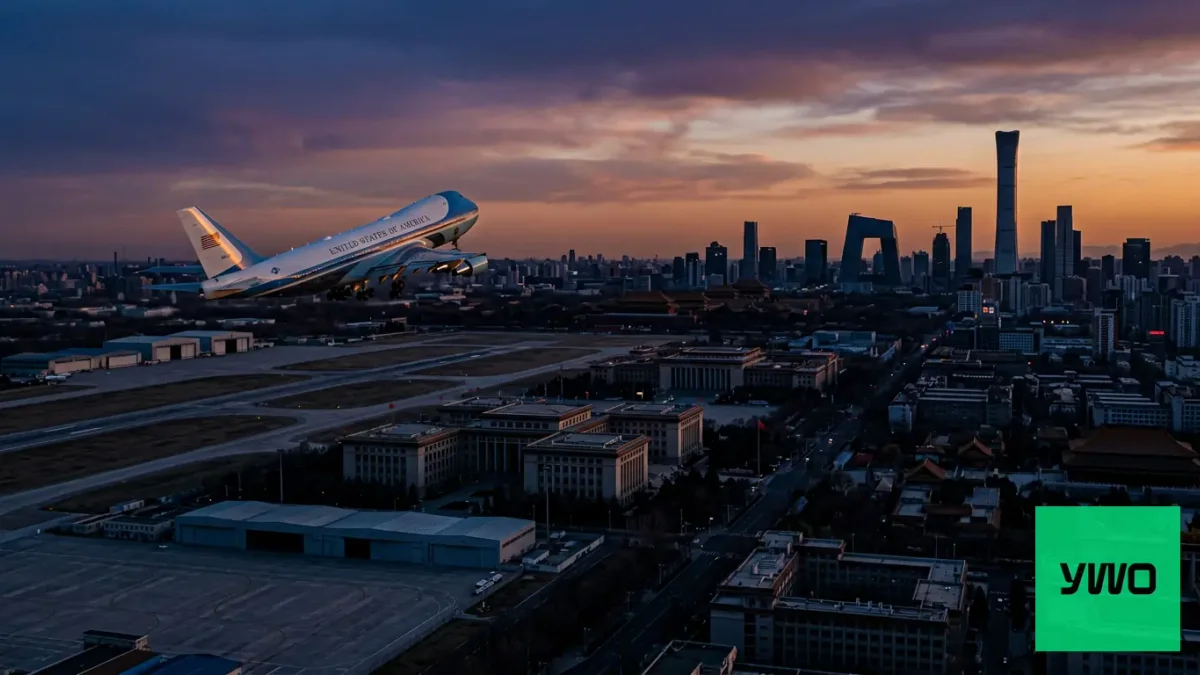
Trump’s departure from Beijing on Friday without a signed trade framework is not a failure — it’s a deliberate deferral, and some analysts may interpret it as a deliberate deferral rather than a failed negotiation .
The headline deliverables announced at Zhongnanhai were real but narrow: China agrees to buy U.S. oil, purchase a significant number of Boeing jets, and withhold military equipment from Tehran. What was conspicuously absent was any announcement on tariffs, technology export controls, or a formal trade structure. Market participants are likely to focus closely on whether the proposed September 24 White House visit is formally confirmed
The framing from Xi’s side was deliberately broad. Chinese state media reported that both leaders agreed to “strategic stability” as a framework for the next three years, according to CNBC’s Evelyn Cheng. That kind of language is diplomatic scaffolding — it signals the relationship has a structure without committing to any specific outcome.
Ryan Fedasiuk of the American Enterprise Institute put the ambiguity plainly, as cited by Cheng: “Frankly, a lot will be left on the tree to ripen further.” That’s the most important sentence out of Beijing this week.
The Boeing Deal Is Real; the Oil Commitment Is Structural
The proposed Boeing purchase was among the more tangible announcements from the summit, and one with immediate equity implications. Boeing has been burning through reputational and financial capital for years; a purchase commitment of that scale from China — even if spread over years and subject to geopolitical backsliding — could influence sentiment around Boeing’s order pipeline .
Traders in BA should note that this is an announced intention, not a signed contract, and the history of U.S.-China aerospace deals shows significant slippage between headline and delivery.
The oil agreement carries different weight. China buying U.S. crude could offer additional support to U.S. production demand dynamics and has historically pressured Gulf producer revenues at the margin. More immediately, Trump’s claim that Xi wants the Strait of Hormuz “open and free of tolls” — if operationalised —could reduce some of the geopolitical risk premium currently reflected in Brent pricing .
Any sustained softening of the Iran supply narrative could push Brent lower, which would relieve cost pressure on global shipping and aviation names but hit energy-heavy indices.
Asian Equity Volatility Points to an Unresolved Market Read
Asian markets on Friday morning told the full story of the summit’s ambiguity, as Katie Foley reported from London. The South Korean Kospi swung from a fresh record high above 8,000 to a 6% loss within hours. The rest of the region was solidly in the red by Friday’s open, with European and U.S. futures tracking lower. That kind of intraday reversal is not a sentiment read on the summit itself — it reflects the broader reality that some analysts suggested markets may have been positioned for more substantial trade progress .
The HSI is the most direct barometer here. Hong Kong equities carry the dual exposure of being sensitive to both Beijing’s policy posture and global risk appetite.
A summit that produces a three-year “strategic stability” framework and a September meeting date may not be sufficient on its own to support a sustained HSI rally. . The diplomatic tone is positive; the substance is thin enough to keep the index rangebound until the September visit either materialises or doesn’t.
For USD/CNY, the read is similarly nuanced. The absence of tariff rollbacks or new punitive measures means no immediate pressure on the yuan in either direction. But the oil-purchase agreement adds a marginal dollar-demand element from the Chinese side, which could provide modest support for the USD against a basket in the near term.
Whether that holds depends on whether the oil deal has any implementation timeline attached — which the source material does not specify.
The Iran Thread Is the Wildcard
Trump said China agreed to help with Iran negotiations and specifically not to supply military equipment to Tehran. That’s geopolitically significant and harder to price than the Boeing headline. U.S.-Iran nuclear talks have been stalled, and Chinese diplomatic leverage over Tehran is material.
If Beijing follows through — and the “if” is substantial — it reduces one tail risk in the Strait of Hormuz, which markets could interpret as reducing some geopolitical premium in crude prices.
For SPX, the Iran dimension cuts both ways. Reduced Hormuz related disruption risk could support broader growth sentiment through lower energy cost pressures. . But traders should weight the probability that this commitment gets operationalised versus remaining a summit talking point. It is an announced intention in a Fox News interview, not a joint communiqué.
The September Date Sets the Next Re-Pricing Window
Hai Zhao, director of international political studies at the Chinese Academy of Social Sciences, told CNBC’s Evelyn Cheng that the September 24 visit “will definitely be a state visit” — framing it as a reciprocal obligation given Trump’s Beijing trip. He noted Xi could also travel through New York, timed around the UN General Assembly earlier in September.
The APEC meeting in Shenzhen in November and the G20 in Florida in December provide two further contact points if September slips.
For traders, this calendar is the key structure. The market has a series of event horizons — September, November, December — at which trade and geopolitical pricing may reset. Between now and September 24, the deal flow from this week’s summit will either show evidence of implementation or quietly fade. The Boeing order and the oil commitment will be the first tests of whether Beijing’s verbal agreements have operational follow-through.
Markets may remain rangebound pending further implementation details or diplomatic developments . . A confirmed Xi visit to Washington could improve broader market sentiment ; a quiet cancellation or indefinite postponement could lead markets to reassess the significance of this week’s diplomatic progress
The Bear Case Has Not Left the Room
The asymmetry here favours caution. The summit was diplomatically successful by any reasonable measure — the imagery from Zhongnanhai, the state dinner, the flag-waving ceremony outside the Great Hall of the People all point to a relationship being managed carefully by both sides. But markets already knew this trip was happening. What traders did not know was whether it would produce structural change on tariffs or technology controls. It did not.
Some analysts may view the summit as having raised expectations without delivering major structural policy changes. . The risk, as Katie Foley noted in her CNBC Daily Open published Friday, is that “uncertainty remains” — which is a polite way of saying the market has a long wait and limited new information to trade on.
Additionally, bipartisan congressional opposition to any U.S. auto market concessions — flagged in the same CNBC report — shows the domestic political ceiling on how far Trump can go in any eventual deal. That constraint matters for the September meeting as much as it did for this one.
What’s Next
The next hard catalyst for USD, CNY, SPX, and HSI on this story is whether Beijing formally confirms Xi’s September 24 Washington visit — watch for Chinese state media and the Ministry of Foreign Affairs. Beyond that, APEC in Shenzhen and the G20 in Florida are the remaining contact points on the calendar per CNBC’s Evelyn Cheng. For broader macro context, monitor the Investing.com Economic Calendar for upcoming U.S. and Chinese trade data releases, which will be the first empirical test of whether this week’s commitments affect actual flows.
Risk Disclaimer: Trading CFDs involves substantial risk and may result in the loss of your invested capital. CFDs are complex instruments and come with a high risk of losing money rapidly due to leverage. You should consider whether you understand how CFDs work and whether you can afford to take the high risk of losing your money. Past performance is not indicative of future results. This content is for informational and educational purposes only and does not constitute investment advice.